THE SACO DRIVE-IN
By R ichard
Julio (projectionist 1998-2014)
ichard
Julio (projectionist 1998-2014)
No one is certain as to the exact birthdate of the first outdoor
movie, but it is quite sure that the first open-air show occurred very early
on in the history of film making. Before the advent of the 'talkies', silent
films were shown outdoors on small screens facing a few rows of benches.
There may or may not have been musical accompaniment, as many of these shows
were informal backyard neighborhood affairs. By 1930, one such backyard
exhibitor was Richard M. Hollingshead, Jr., a 30 year old manager of his
father's auto parts store. Hollingshead tinkered with the notion of mounting
a 1928 Kodak projector to the hood of his car, and projecting the show onto
a white sheet as a makeshift screen. Maybe his fascination with the open
air theater goes back to his teen years at Ebbet's Field, New York, where
in 1914 Marcus Loew had put on an exhibition of 'Wrath Of The Gods' to boost
WWI spirits. The event was overwhelmed by the attendance of more than 21,000
people. Americans loved the great outdoors as much as they loved the movies.
Richard Hollingshead perfected his outdoor exhibitions by experimenting
and placing a large radio speaker behind the screen to broadcast sound.
In driveway tests with neighbors, he noticed that cars parking closely behind
each other were not able to see the entire screen. He solved this problem
by spacing the rows of cars at precise distances, and elevating the front
wheels with wooden blocks to adjust the angles for optimum viewing. In an
open lot, mounds of dirt & gravel were built up into ramps, or 'burms'
to facilitate the viewing, and this innovation became the basis for his
1933 patent. Thus, the first Drive-in Theater was designed and built by
inventor Richard Hollingshead, listed as #92 out of the one hundred most
influential people in the history of the movies. He got the show on the
road, so to speak, by opening the Camden Drive-in Theater in Camden New
Jersey on June 6, 1933. Their first show that night was "Wife Beware". Admission,
25 cents.
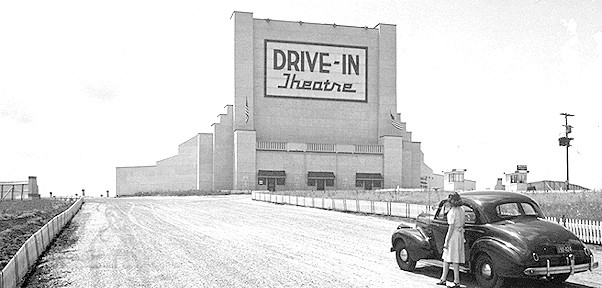
List of Drive-in Theaters Started 1933-1939
BRIEF HISTORY OF THE SACO DRIVE-IN
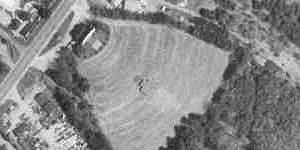
The Saco Drive-in is located on US Route One, "The Avenue Of America",
and was billed as "The Showplace Of Maine" by its founder, Eugene V. Boragine.
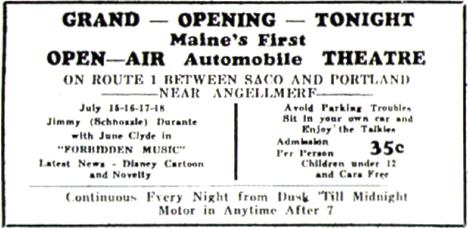
Ground was broken in 1938, and the Saco Drive-in opened its gates for
the first time on July 15, 1939 with a showing of "Forbidden Music", starring
Jimmy Durante. Children under twelve were admitted free, while all others
paid thirty-five cents. Opening ads proclaimed it as "Maine's first open-air
automobile theatre. Avoid parking troubles. Sit in your own car and enjoy
the talkies. Motor in anytime after 7 PM". The Saco Drive-in is not only
the first drive-in built in Maine, it's the 17th drive-in ever built,
and is currently enjoying its status as the 2nd oldest drive-in in the
nation!
The Saco Open Air Automobile Theatre, also known as The Auto Drive-in,
changed its name to The Saco Drive-in in the 1950s. At its peak during
the 1950's Maine had a total of 36 drive-ins operating, but only 5 of
those were still in operation by 1999, and there are even less than that
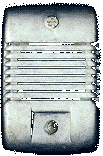
today. Originally, speakers were placed around the theater and patrons
had to leave their car windows open to hear the movie. Car speakers with
individual volume control were patented in 1941, but production was delayed
until 1946 because of World War II. Things have changed quite a bit since
then. In the summer of 1998, The Saco Drive-in began broadcasting in stereo
over FM radio, making car window speakers a thing of the past. In 2014,
after 75 consecutive years of running film, the Saco Drive-In updated
to digital projection, allowing it to stay competitive in acquiring the
latest titles for summer visitors.
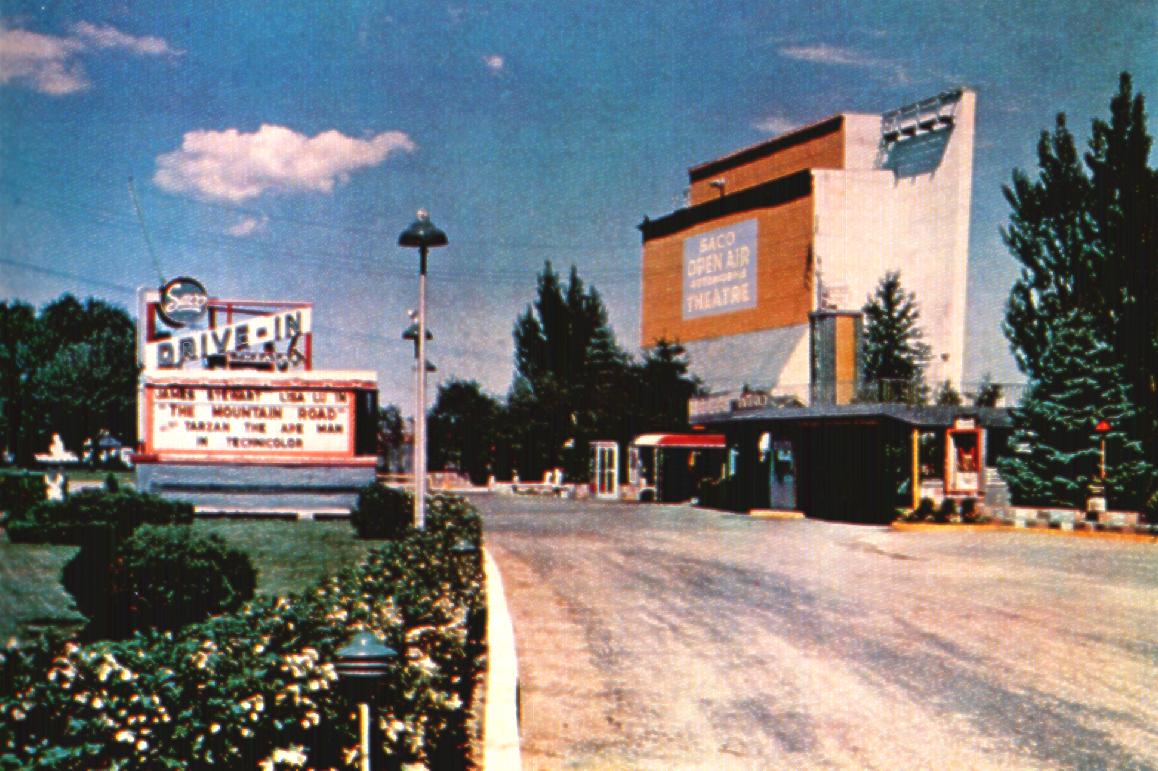
This photo shows the Saco Drive-in in 1960, playing the feature first,
"Mountain Road" starring James Stewart. The co-hit "Tarzan The Ape Man"
is in Technicolor from 1959. The back of the screen says: Saco Open Air
Automobile Theater. Today, the trees are fully grown, making it difficult
to see the back of the screen. The elaborate short concrete walled gardens
& marquee from 1939 have given way to the widening of US Rt. 1. However,
the 'teardrop' concrete bases on the speaker posts remain in evidence,
as well as some nifty porcelain-enameled downlights nestled
within the trees. Some general maintenance will bring the theater
back to its former glory.
ONE OF THE MANY STORIES FROM THE SACO DRIVE-IN
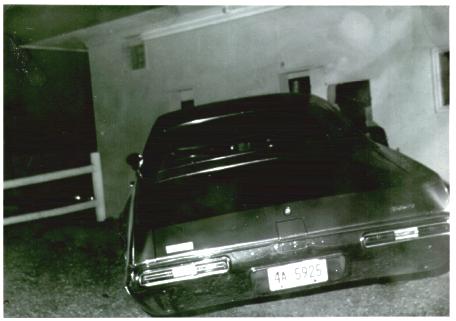
During the summer of 1967 a Canadian Judge came to the drive-in in his
brand new 1967 Oldsmobile Toronado. Projectionist Hugh L. Howard (1966-1970)
was watching the credits going by at the end of movie, when he saw headlights
coming his way from over the ramps. He dove out of the way just as the
car crashed through the fence and into the projection booth at full throttle!
The car ruined the #1 projector and sound amplifiers, and of course
caused major building damage. No one was hurt, and the projectionist commented
that he knew the movie was bad, but didn't think it warranted wrecking
the projection booth! One of many interesting stories and happenings at
the Saco Drive-in.
THE MOVIE LOFT
| HOME PAGE | CLOSE
WINDOW